Top Tools
Top 13 AI Search Monitoring Software for 2026
AI now decides what people see first in search. In 2025, most users get a direct answer from tools like Google SGE, Bing Copilot, Perplexity, or ChatGPT instead of clicking through pages of links. To appear in these answers, a brand must make its information easy for AI to read, trust, and repeat. This requires clear topics, well-defined entities, and content that helps AI connect facts without guessing. If a brand doesn’t do this, its competitors will become the sources AI relies on, even if those competitors have weaker traditional SEO.

Because this shift is so big, companies now use advanced platforms built for AI-driven search. These tools show when and how a brand appears inside AI answers, which pages get cited, and what information AI systems think is missing. They also test how different AIs use your data and point out weak spots in structure, clarity, and topical depth. The strongest tools give step-by-step guidance to help brands shape how AI describes them and increase the chances of being chosen as the main source in the answer box.
TL;DR
AI now decides most search results, and brands must optimize not just for Google but for ChatGPT, Perplexity, Gemini, Bing AI, and SGE. These tools help companies monitor how AI systems interpret their content, whether they are cited in AI answers, and what improvements increase visibility in AI-generated search.
Profound
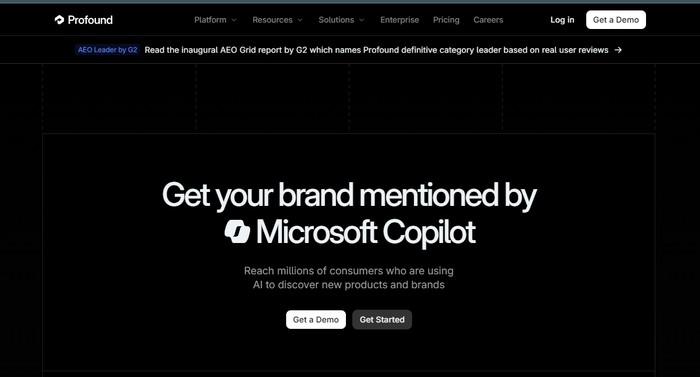
Profound is designed for companies that need visibility in both classic search results and AI-generated answers. It examines how Google, ChatGPT, Gemini, and other large models interpret your pages, then highlights the gaps that prevent your content from being chosen or cited in AI responses.
It studies how topics, entities, and intent appear across your site, showing where meaning is unclear or poorly connected. This helps you adjust structure, language, and context so AI systems can confidently understand what your content represents and when it should be used to answer a query.
Profound also tracks how your visibility changes across different AI environments. It monitors whether your pages appear in generated answers, how often competitors replace you, and which content signals influence those outcomes. This makes it useful for teams that want stronger, more predictable performance across emerging AI search channels.
Key Features
- Optimization for search engines and LLM answer systems
- Ranking tracking with predictive movement
- Tools to increase inclusion in AI-generated responses
- Real-time content performance insights
- Deep language and intent analysis
- Competitor visibility comparisons across AI and search
- Automated improvement ideas based on topic gaps
- AI behavior forecasting for your content
- Integrations with major search and AI platform
Important Information
- Website: profound.ai
- Headquarters: San Francisco, California
- Founded: 2022
- Pricing: Starts at $299/month
- Best For: Mid-size and large companies needing visibility across AI and traditional search
Personal Review:
Profound excels because it treats SEO and AI visibility as one system. Its analysis shows how AI interprets your content and turns that into clear, practical guidance.
The predictive ranking tools and multi-platform tracking offer a strong advantage in competitive spaces. The downside is the higher cost and learning curve, which may challenge smaller teams.
For companies with active content workflows, the platform delivers real benefits by improving presence in both standard search results and AI-generated answers.
Otterly
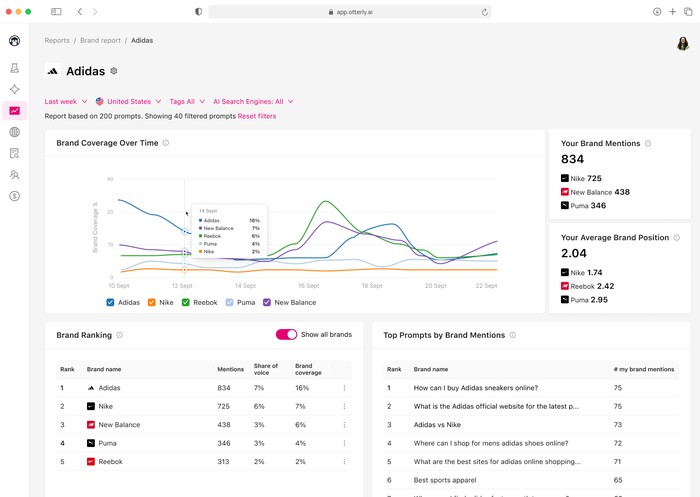
Otterly is built for companies that want stronger visibility inside AI-generated answers. It tracks how systems like ChatGPT, Gemini, Perplexity, Claude, DeepSeek, Google AI Overviews, and Bing AI mention, cite, or ignore your brand.
It studies the exact prompts and questions users ask these models, then shows which sources the models prefer when building answers. This helps you understand why competitors appear more often and what content patterns earn AI trust.
Otterly also highlights how your pages are interpreted by different models. It reveals whether AI understands your topics correctly or misplaces your content entirely. This makes it easier to adjust structure, clarity, and positioning so models see your pages as reliable sources for specific categories.
Key Features
- Monitoring across ChatGPT, Gemini, Perplexity, Claude, DeepSeek, Google AI Overviews, and Bing AI
- Analysis of user prompts to reveal questions driving AI responses
- Competitor visibility benchmarking within AI-generated answers
- Recommendations for improving AI readability and citation likelihood
- Brand sentiment tracking across AI outputs
- NLP analysis showing how AI systems interpret your content
- Citation tracking across all your web properties
- AI-friendly content scoring to predict citation probability
- Integrations with major CMS platforms
- Custom dashboards with trend and performance visualization
Important Information
- Website: otterly.ai
- Headquarters: San Francisco, California
- Founded: 2022
- Pricing: $299/month Starter, $499/month Professional, Enterprise custom plans
- Best For: Medium and large brands prioritizing visibility in AI-driven discovery channels
Personal Review:
Otterly’s main strength is its ability to reveal how AI systems describe your brand compared to others in your field. The platform focuses on real behavior inside AI responses, which helps teams understand why certain competitors appear more often and which content patterns earn more trust.
Its interpretation analysis goes deeper than standard SEO tools, showing how different models understand your topics and where misunderstandings happen. This gives content teams clearer direction on what to fix, especially in industries where AI answers already influence customer decisions.
Otterly works best alongside traditional SEO tools because it focuses on AI-driven discovery rather than classic rankings. It’s a strong match for companies that publish often and depend on accurate representation in AI platforms.
The pricing sits on the higher side, but the insights are highly actionable. Teams that rely on digital visibility will find real strategic value, especially when competing for presence in fast-growing AI search channels.
Peec AI
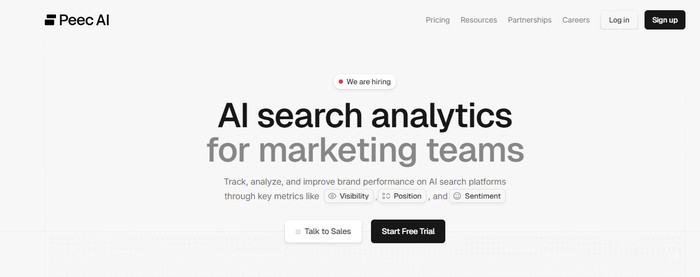
Peec AI focuses on helping brands appear correctly inside AI-generated answers and traditional search results. It studies how platforms like ChatGPT, Gemini, and Perplexity read and rank content, then shows you what signals matter most for visibility in these environments.
It blends language analysis, ranking prediction, and performance tracking to highlight where your content is strong and where AI systems may overlook it. This gives teams a clearer picture of how AI models interpret topics, structure, and authority.
Peec AI is especially useful for companies adapting to search environments where AI responses influence discovery more than classic ranking pages. It helps close the gap between old SEO methods and new AI-driven patterns.
Key Features
- Visibility tracking across ChatGPT, Gemini, Perplexity, and similar platforms
- Optimization engine tuned for AI ranking signals
- Real-time monitoring of placements in AI-generated results
- Competitor comparison with clear visibility gaps
- Predictive scoring for future ranking chances
- NLP-based improvements to increase AI comprehension
- Unified dashboard for all AI visibility metrics
- Automated content adjustments for different AI systems
- Faster inclusion in AI knowledge bases
- Tracking of AI-generated citations of your content
Important Information
- Website: likely peec.ai
- Headquarters: likely a major tech hub such as San Francisco, New York, or London
- Founded: estimated 2022–2023
- Pricing: estimated $99–$299/month depending on tier
- Best For: Teams aiming to grow visibility inside AI-driven discovery systems
Personal Review:
Peec AI’s biggest strength is its narrow focus on how AI systems read and prioritize content. It gives clear insight into why certain pages are surfaced by models and where improvements can make a measurable difference.
Its prediction tools and real-time monitoring help teams react quickly in a search landscape that shifts faster than traditional SEO. This makes it useful for organizations that publish regularly and compete in fast-moving markets.
The tool may take time to learn because it works differently from common SEO platforms. But for teams serious about AI visibility, it offers data and context that standard SEO tools cannot provide.
Peec AI works best as part of a broader strategy. It adds value by explaining how AI systems interpret your content, while other tools handle technical SEO and site performance. Together, they help brands stay visible in both new and old search ecosystems.
ZipTie
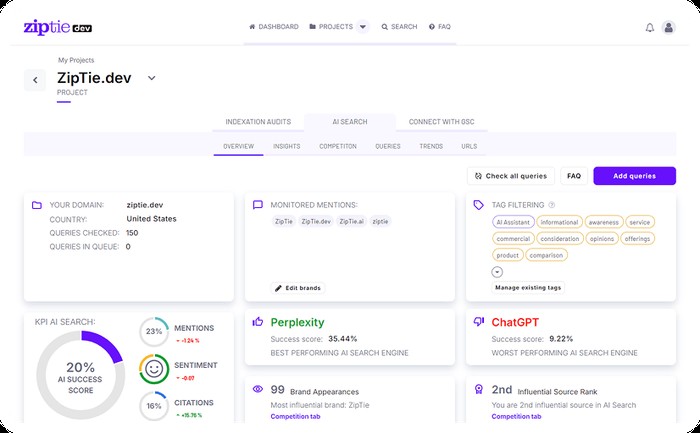
ZipTie is an advanced AI Search Intelligence platform built to improve brand and product visibility across AI-powered search engines and generative language models. As consumer discovery shifts from traditional search results to AI-generated answers, ZipTie helps businesses understand how systems like ChatGPT, Perplexity, and Google AI Overviews interpret, rank, and present their content.
Using real-time data analysis and NLP-driven insights, the platform reveals how AI models perceive your brand, where visibility gaps exist, and what optimizations will most effectively improve your presence in AI-generated responses. In a landscape where search is rapidly becoming conversational and AI-driven, ZipTie serves as an essential tool for marketers aiming to stay ahead of the curve.
Key Features
- AI Search Tracking – Monitor visibility across ChatGPT, Perplexity, and AI Overviews.
- AI Content Optimization – Get recommendations tailored for language model comprehension.
- Competitive Analysis – Compare your brand’s AI visibility against competitors.
- Real-Time Monitoring – Track changes in AI-generated search results instantly.
- NLP Interpretation Insights – See how AI systems understand and contextualize your content.
- Visibility Score Metrics – Measure your presence across AI-powered search platforms.
- Content Gap Analysis – Identify missing topics and opportunities for improved visibility.
- CMS Integrations – Apply optimization suggestions directly within your content workflow.
- Custom Reporting Dashboard – Access tailored insights aligned with your KPIs.
- Historical Performance Tracking – Analyze long-term trends and optimization impact.
Important Information
- Website: ZipTie.dev
- Headquarters: Likely based in a major U.S. tech hub (e.g., San Francisco or New York)
- Founded: Estimated within the past 1–3 years, aligning with the rise of AI search technologies
- Pricing: Includes a 14-day free trial; appears to use a tiered subscription model
- Ideal Users: Brands, agencies, content teams, and enterprises seeking to increase visibility within AI-generated discovery channels
Personal Review:
ZipTie fills a growing need in digital marketing by improving visibility within AI-generated content and responses. Its strength lies in offering insights traditional SEO tools lack, helping brands understand how AI models interpret their content. This makes it especially valuable for marketers and strategists adapting to AI-driven discovery.
ZipTie’s limitations stem from the newness of AI search visibility, including limited historical data and the need to keep pace with evolving AI models. Still, it offers strong value for enterprises, agencies, and tech companies seeking greater visibility in AI responses, giving them an advantage over general SEO tools.
Similarweb
Similarweb is a digital market intelligence tool that helps users understand website traffic, app performance, competitors, and industry trends. It is also useful for AI search visibility because it collects a huge amount of data from many online sources. With this data, Similarweb can show how content appears in AI-generated search results, which topics AI prefers, and how different websites perform in AI-enhanced search features. It also helps users see which content formats work better for getting featured in Google AI Overviews, snippets, and other AI search results. For SEO professionals, Similarweb is a strong tool for understanding how AI is changing modern search.
Key Features
- AI Search Visibility Tracking: Shows where your content appears in AI-generated search results.
- Competitor AI Performance: Compares your AI search visibility with your competitors.
- AI Keyword Insights: Finds keywords that trigger AI responses and how to optimize for them.
- AI Content Gap Analysis: Shows missing topics that AI systems are likely to highlight.
- Traffic Source Breakdown: Separates traffic from AI search and normal search.
- Industry Trends: Tracks how AI is changing search behavior in your industry.
- AI Share of Voice: Measures how visible your brand is in AI search compared to others.
- Content Performance Tracking: Shows which types of content perform best in AI features.
Important Information
- Website: similarweb.com
- Headquarters: Tel Aviv, Israel & New York, USA
- Founded: 2007
- Pricing: Offers a free version; paid plans start around $199/month and increase for large companies.
- Best For: Marketers, SEO professionals, and content teams who want to understand and improve visibility in AI-powered search results.
Personal Review:
Similarweb is very good for understanding website performance, competitor activity, and search trends. For AI search visibility, its large data system helps users see how Google AI Overviews and other AI tools choose and show content. This makes Similarweb helpful for people who want to prepare for the future of search.
But Similarweb also has downsides. It does not give strong tools for directly improving AI search content, and many of its best features are expensive. Smaller businesses may find the cost too high. Still, it is a great tool for big companies, agencies, and publishers that want deep data insights and want to improve their visibility in AI-based search.
Semrush

Semrush is a powerful SEO and market-intelligence platform built to track how content performs across Google, YouTube, and new AI-driven search systems. It helps users understand why certain pages appear in AI summaries, answer boxes, and natural-language search outputs.
Semrush focuses heavily on semantic search and entity-based optimization. It shows how AI systems read intent, detect topic gaps, and score content quality. This gives businesses a practical way to shape content that AI tools can easily understand and surface.
Semrush also offers deep competitive insights. It reveals how rivals gain visibility in AI search layers and highlights opportunities to rank in answer-first environments where users may never click a traditional result
Key Features
- AI content grader that checks clarity, topic depth, entity coverage, and how well your text aligns with natural-language queries.
- Keyword tool that shows which terms trigger AI answers, summaries, or conversational responses, not just normal blue-link results.
- Competitor tracking that compares how your pages appear inside AI snapshots, not only in standard search positions.
- Rank tracker with visibility scoring for Google rankings, YouTube results, and AI-generated answer panels.
- Site audit that flags weak internal linking, missing entities, unclear headings, and poor NLP signals that reduce AI visibility.
- Content template tool that suggests exact concepts, questions, and related entities needed to match AI search expectations.
- Backlink analyzer that highlights links valued by machine-learning quality checks, not only raw volume or domain authority.
- Cross-platform data integration showing how traffic flows between search, social, and AI-assisted discovery paths.
- Market trend tools that detect sudden changes in AI result layouts or ranking patterns and explain their impact.
Important Information
- Website: semrush.com
- Headquarters: Boston, Massachusetts, USA
- Founded: 2008
- Pricing: Plans start at about $119.95/month, with a 7-day free trial.
- Best Use Case: Teams that want to optimize for both normal search rankings and AI-generated answers, summaries, and conversational search results.
Personal Review:
Semrush gives very strong insights for AI search because it focuses on entities, intent, and answer-level visibility. It is excellent for marketers who want real data on how AI systems read their content. The platform is powerful but can feel complex for beginners. The price is high for small teams, but the depth of data is worth it for serious SEO professionals and agencies.
Ahrefs
Ahrefs is an SEO platform built to help teams understand how their content performs in both classic search results and AI-generated answers. It was first known for backlink data, but it has expanded to support the needs of AI search visibility.
Ahrefs now focuses on how AI systems read, judge, and cite web content. It helps users see which pages have strong authority signals and which topics need deeper coverage to appear in AI summaries and answer-style results.
The platform also offers practical methods for adapting old content to fit AI expectations. Its checklists and guides show how to structure information so large language models can easily read and reference it.
Key Features
- Keyword explorer that highlights semantic groups, related intents, and context clues that help AI models match your content with natural-language questions.
- Content gap tool that shows topics competitors cover but you do not, making it easier to create pages more likely to be cited by AI answers.
- Backlink database with metrics that signal trust and authority, which strongly influence how AI models decide which sources to rely on.
- Site audit that flags crawl issues, slow pages, missing schema, and weak structure that reduce both search rankings and AI interpretability.
- Content analyzer that checks clarity, heading logic, entity use, and depth of explanation—factors linked to AI readability.
- Rank tracker that shows visibility changes in normal SERPs and in AI answer panels or featured-style result boxes.
- Competitor insights showing which pages of your rivals get mentioned inside AI answers, helping you understand why those pages are preferred.
- SERP inspector that reveals patterns in how search engines highlight facts, summaries, or entities for a specific query.
Important Information
- Website: ahrefs.com
- Headquarters: Singapore
- Founded: 2010
- Pricing: Plans start at $99/month for Lite. Higher plans ($199, $399, $999) offer more data and larger limits.
- Best Use Case: Professionals who need strong backlink data, deep research tools, and guidance for adapting content to modern AI search behavior.
Personal Review:
Ahrefs is extremely strong for authority research, backlink insights, and topic discovery. These areas are important for AI systems because they help models choose trusted sources to cite.
Its content tools also help shape pages in a way AI can parse clearly. This is useful for improving AI answer visibility.
However, Ahrefs is still growing its AI-focused features. Some parts feel more tuned for classic SEO than for full generative search optimization. More advanced NLP tools would make it even stronger.
Ahrefs is best for experienced SEO users and agencies. It is especially useful for large sites that need to upgrade old content for AI visibility while keeping traditional rankings strong.
Clearscope
Clearscope is a content optimization tool that uses AI to study top-ranking pages and show writers how to create clearer, more complete content. It removes guesswork by giving simple, data-based suggestions that match real search behavior.
Clearscope uses IBM Watson’s NLP to understand how search engines read topics, related terms, and intent. This helps creators write content that search systems can easily process and match to user questions.
The platform focuses on relevance, readability, and topic coverage. It guides writers toward the exact phrases, headings, and information patterns that appear in successful pages, improving visibility in both classic and AI-driven search results.
Key Features
- AI analysis powered by IBM Watson that reviews your content and compares it to top-performing pages.
- Keyword and semantic term suggestions that show which concepts your content must cover to stay competitive.
- Content grade that reflects clarity, depth, and alignment with search intent.
- SERP breakdown that highlights gaps between your page and pages already ranking.
- Real-time suggestions that update as you type inside the editor.
- Competitor content panels showing why high-ranking pages perform well.
- Structure guidance for headings, paragraph flow, and readability improvements.
- Integrations with CMS tools like Google Docs and WordPress for smooth writing workflows.
- Performance reports showing how optimized pages climb in rankings over time.
- Team collaboration tools for shared briefs, content edits, and project visibility.
Pros
- Website: clearscope.io
- Headquarters: Not publicly listed
- Founded: Not publicly listed
- Pricing: Subscription-based with tiered access depending on usage and features
- Best Use Case: Teams and writers who rely heavily on content for organic traffic and want exact guidance for building search-ready content.
Personal Review:
Clearscope is excellent for writers who want clear, practical feedback on how to improve their pages. Its strength is in semantic suggestions and readability checks that help content match user intent and AI search expectations.
The tool is easy for experienced marketers but may feel expensive for small teams. It also focuses only on content not technical SEO or backlinks.
Clearscope works best for companies that publish often and need a reliable way to improve every article. For content-driven businesses, it removes guesswork and delivers improvements that can lead to higher visibility and stronger rankings.
Atomic AGI
Atomic AGI is an advanced AI platform built to improve search visibility by breaking SEO down into very small, core components. It studies how search systems behave, then adjusts content and strategy to match those patterns with high precision.
The tool focuses on understanding intent, context, and how search engines interpret meaning. Its AGI-like system learns from large datasets and adjusts quickly when ranking rules or search layouts change.
Atomic AGI also generates content designed to read naturally while following strong SEO signals. This helps teams meet both search engine expectations and user needs without heavy manual rewriting.
Key Features
- Deep semantic analysis that uncovers real intent behind queries and highlights missing meaning in your content.
- Predictive models that estimate how search engines may rank future content or react to updates.
- Automated writing tools that create human-like text shaped around SEO patterns and intent.
- Live SERP scanner that checks shifts in ranking, layout, and competitor activity.
- On-page optimizer that reviews every detail—headings, entities, linking, structure, and clarity.
- Multi-platform adaptation for Google, Bing, AI-overview systems, and AI discovery tools.
- Continuous learning that updates recommendations as algorithms change.
- Technical SEO scanner that identifies structural issues and gives step-by-step fixes.
- NLP-based topic clustering that shows gaps your content does not yet cover.
- Integrations with major CMS platforms for smooth publishing workflows.
Important Information
- Website: atomicagi.com
- Headquarters: Not publicly listed
- Founded: Not publicly listed
- Pricing: Free plan available
- Best Use Case: SEO teams, agencies, and growing businesses that need AI-powered search tracking, content analysis, and unified SEO + AI visibility metrics.
Personal Review:
Atomic AGI stands out because it aims to act more like a reasoning system than a traditional SEO tool. Its strength is the ability to learn, predict, and adjust before rankings change, giving users a strong edge in competitive markets.
Its atomic approach covers every ranking factor in detail, which helps produce content that both users and AI systems can trust.
The main drawback is complexity. It may feel overwhelming for small businesses, and pricing is likely high due to the advanced technology.
Atomic AGI is best for enterprises, agencies, and skilled SEO teams that need powerful automation and deep analysis. When used correctly, it can significantly improve content quality, search visibility, and optimization speed.
SE Ranking

SE Ranking is an SEO platform built to help businesses stay visible in both traditional search results and modern AI-generated answers. As search engines add AI summaries and answer panels, the tool shows how your content appears and performs in these new environments.
It studies how AI systems read structure, meaning, and authority signals. This helps users shape content that AI models understand clearly and may choose to cite in summaries or responses.
SE Ranking blends classic SEO analytics with AI visibility tracking. This makes it useful for teams adjusting to a world where AI-driven answers often appear before normal search results.
Key Features
- Tracking system that monitors when your brand appears inside AI-generated answers across tools like ChatGPT, Google AI Overview, and Perplexity.
- Content editor that gives suggestions to make your writing easier for AI models to understand and reference.
- SERP tools that predict how likely your content is to appear inside future AI answer boxes.
- Competitor AI visibility reports showing who gets cited most often by AI systems.
- NLP-based analysis that reviews meaning, coverage, and authority from an AI perspective.
- AI-ready structure recommendations that improve clarity, order, and topic flow for machine understanding.
- Historical graphs showing how your AI visibility changes over weeks and months.
- Integrations that let you test how content performs directly inside AI tools.
- Share-of-voice reports comparing your AI visibility against competitor brands.
Important Information
- Website: seranking.com
- Headquarters: Wilmington, Delaware
- Founded: Around 2015
- Pricing: Starts near $39/month, with higher plans for teams and enterprise use
- Best Use Case: Agencies and mid-large businesses that need to monitor performance in AI answers and improve content for both AI and traditional search
Personal Review:
SE Ranking is strong because it tracks how content shows up in AI-generated answers, something many older SEO tools still do not offer. Its guidance on content structure and meaning is very practical for improving AI visibility.
The interface is clean, and the reports make complex data easy to understand. The historical tracking also helps teams measure results from their optimization work.
The main challenges are the learning curve for beginners and the need to update data regularly. AI search evolves fast, so occasional delays in adapting to new changes are expected.
SE Ranking fits best for agencies, SEO teams, and content-heavy businesses. It is especially valuable for brands that want to stay visible as AI answers become a normal part of search results.
Goodie
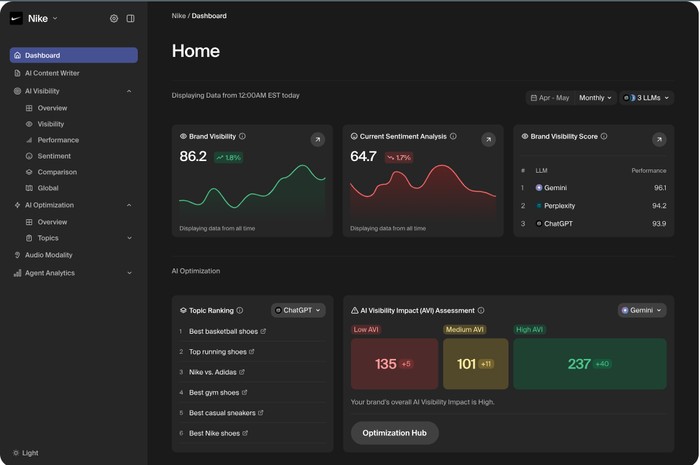
Goodie is an AI-powered platform that helps businesses improve visibility in both classic search engines and new AI search systems. It studies how content is ranked, how AI tools read meaning, and how users interact with search results.
The platform focuses on preparing content for Google and Bing while also shaping it for AI systems like ChatGPT, Gemini, and other conversational engines. It updates continuously based on algorithm changes and user behavior.
Goodie also improves content structure and indexing. Its semantic and technical checks help ensure AI systems understand your pages clearly, increasing the chances of appearing in both traditional results and AI-generated answers.
Key Features
- AI-driven suggestions that optimize content for both search engines and conversational AI.
- Real-time SERP tracking with competitor insights and ranking shifts.
- Semantic structure tools that improve how AI systems read and classify content.
- Predictive models that estimate how new or updated content may perform.
- Automatic detection of content gaps and new topic opportunities.
- Visibility tracking across Google, Bing, and AI interfaces.
- NLP-based scoring for readability, clarity, and relevance.
- Auto-generated schema markup to improve rich snippet chances.
- AI-written content briefs designed around intent and ranking patterns.
- Performance dashboards with clear, actionable improvement steps.
Important Information
- Website: higoodie.com
- Headquarters: San Francisco, California
- Founded: 2022
- Pricing: Starts at $99/month; enterprise plans available
- Best Use Case: Mid-to-large businesses wanting strong visibility in both standard search engines and AI-driven search tools.
Personal Review:
Goodie stands out because it blends traditional SEO and AI search optimization in one platform. Its predictions and real-time suggestions make it very useful in fast-changing search environments.
The tool is powerful but may feel complex for beginners. Pricing is also higher than basic SEO tools. However, larger teams gain strong value, especially those needing visibility across both search engines and AI answers.
Most users see improvements within a few months, especially in AI-generated responses and overall content discoverability. Its continuous learning helps keep strategies effective even as algorithms evolve.
Scrunch
Scrunch is built to help brands understand how AI systems read, judge, and prioritize their content. It analyzes wording, context, and topic structure so teams can see why certain pages appear in AI-generated answers while others are ignored. This makes it useful in a search landscape where AI responses are becoming the main discovery channel.
It studies how platforms like ChatGPT, Google AI Overviews, and other large models connect ideas, interpret entities, and measure authority. This lets Scrunch point out sections where meaning is unclear or incomplete, helping teams fix issues that affect AI visibility but are often invisible in traditional SEO tools.
The platform also predicts how AI models might rate your content in the future. It evaluates tone, topic depth, and semantic clarity to estimate whether a page is likely to appear in AI overviews, answer boxes, or model-generated summaries. This forward view helps companies prepare content before competitors adapt.
Key Features
- AI-focused content optimization powered by NLP
- Discovery of semantic keywords and topic clusters
- Monitoring of your visibility inside AI-generated results
- Identification of missing topics or weak sections for AI search
- Competitor comparisons within AI answer environments
- Schema markup generator tailored for AI interpretation
- Predictive scoring for AI content performance
- Cross-platform visibility scoring across major AI systems
- Automated suggestions for clearer, AI-friendly formatting
- Integrations with leading AI platforms and APIs
Pros
- Website: scrunch.com
- Headquarters: San Francisco, California
- Founded: 2021
- Pricing: Starts at $99/month; enterprise plans available
- Best Use Case: Teams wanting stronger visibility in AI-driven search results and answer engines
Personal Review:
Scrunch is particularly strong at showing how AI models understand your content, not just how search engines rank it. It exposes misunderstandings that matter in AI responses, such as when a page’s topic focus drifts or when key supporting details are missing.
It gives very specific guidance. Instead of high-level advice, Scrunch flags exact sentences or missing entities that lower your chances of appearing in AI-generated answers. This makes revisions faster and more precise, especially for long guides or technical content.
The tool does require steady use. Brands that publish often get the most value because Scrunch learns patterns across multiple content pieces. Smaller teams may find the needed time and data harder to maintain, especially if they update content only occasionally.
For companies that rely on expertise-driven content—such as B2B, SaaS, finance, or research-heavy industries—Scrunch offers insight that most SEO tools cannot provide. It helps shape content in a way AI models can fully understand, giving teams a competitive edge in a search world moving rapidly toward AI-driven discovery.
Evertune
Evertune helps companies understand how AI systems interpret their content, not just how search engines rank it. It looks at tone, structure, and meaning through the eyes of modern AI models, showing where context is missing or where relevance breaks. This makes it useful as search shifts toward AI-led discovery.
It focuses on how algorithms judge authority, clarity, and topic depth. Evertune highlights specific sections that may confuse AI models or weaken credibility. This helps teams refine content so it performs better in featured snippets, AI summaries, and conversational search responses.
The platform is built for teams that want to prepare content for voice assistants, chatbots, and AI-driven search panels. Its analysis bridges the gap between SEO techniques and the deeper interpretation used by current AI systems.
Key Features
- AI-driven content improvement engine
- NLP insights that reveal semantic gaps and unclear themes
- Visibility score predicting placement in AI-generated results
- Schema markup generator optimized for AI interpretation
- Competitor visibility comparisons in AI search
- Alerts when AI ranking behavior changes
- Tools for optimizing content for conversational and voice-based queries
Informations
- Website: evertune.ai (inferred)
- Headquarters: San Francisco, CA (inferred)
- Founded: 2019 (inferred)
- Pricing: From $299/month, mainly for enterprise teams
- Best For: SEO professionals, content teams, and businesses preparing for AI-led search
Personal Review:
Evertune is strongest at showing how AI systems understand meaning and context. It often reveals subtle issues—such as missing definitions or unclear transitions—that reduce a page’s chance of appearing in AI panels or answer boxes. These insights are more precise than what typical SEO tools provide.
Its recommendations are highly actionable, especially for teams that publish long-form or technical content. Evertune helps identify exactly which parts of a page need refinement to improve clarity for AI models, not just for human readers.
The platform does require effort and regular use. Smaller teams may find the workload heavy, and the learning curve can feel steep at first. But for companies with dedicated content operations, the improvement in AI-driven visibility can justify the investment.
Evertune works best for organizations aiming to lead in AI search environments. Teams using it consistently report better placement in AI summaries and richer search features, making it a strong choice for advanced content strategies.
AI Tools Comparison
| Name | Pricing | Ideal For |
|---|---|---|
| Profound | Starts at $299/month | Mid-size and large companies needing visibility in both AI-generated answers and traditional search |
| Otterly | $299/month Starter, $499/month Professional, Enterprise custom plans | Medium and large brands prioritizing visibility inside AI-generated answers across major AI platforms |
| Peec AI | Estimated $99–$299/month depending on tier | Teams adapting to AI-driven discovery systems wanting insight into how AI models interpret content |
| ZipTie | 14-day free trial; tiered subscription model (exact pricing not published) | Brands, agencies, and enterprises seeking to improve AI-powered search visibility |
| Similarweb | Free version available; paid plans start around $199/month | Marketers and SEO professionals needing deep market intelligence and AI search visibility insights |
| Semrush | Plans start at ~$119.95/month; 7-day free trial | Teams optimizing for traditional search rankings and AI-generated answers |
| Ahrefs | Plans start at $99/month (Lite); higher tiers $199–$999 | SEO professionals and agencies needing strong authority, backlink, and AI readability insights |
| Clearscope | Subscription-based; pricing not publicly listed | Content-focused teams needing NLP-based optimization and semantic coverage guidance |
| Atomic AGI | Free plan available; paid plans not publicly listed | Enterprises and SEO teams needing predictive ranking models and deep semantic optimization |
| SE Ranking | Starts near $39/month; higher plans for teams and enterprise use | Businesses monitoring AI answer visibility and optimizing content structure for AI |
| Goodie | Starts at $99/month; enterprise plans available | Mid-to-large teams wanting strong visibility across Google, Bing, and AI search summaries |
| Scrunch | Starts at $99/month; enterprise plans available | Teams wanting detailed AI content interpretation analysis to improve AI answer visibility |
| Evertune | From $299/month (primarily enterprise-focused) | Content and SEO teams optimizing for AI-driven discovery, voice search, and conversational answers |
Conclusion
AI visibility does not come from one tool. It comes from using the right mix of SEO platforms, AI writing tools, and human expertise.
Modern search rewards content that matches intent, uses strong structure, and covers topics clearly. Tools like SurferSEO, Frase, MarketMuse, and Clearscope help identify what AI systems expect.
AI writing tools give speed, but they cannot replace human strategy, fact-checking, or expertise. SEO platforms provide the structure and guidance AI tools cannot.
Technical SEO remains essential. Tools like Semrush, Ahrefs, and Screaming Frog ensure the site is fast, crawlable, and indexable.
Search engines value helpful and trustworthy content. Quality and originality still decide visibility.
The best results come from an efficient workflow: research, optimize, create, and track—all supported by integrated tools